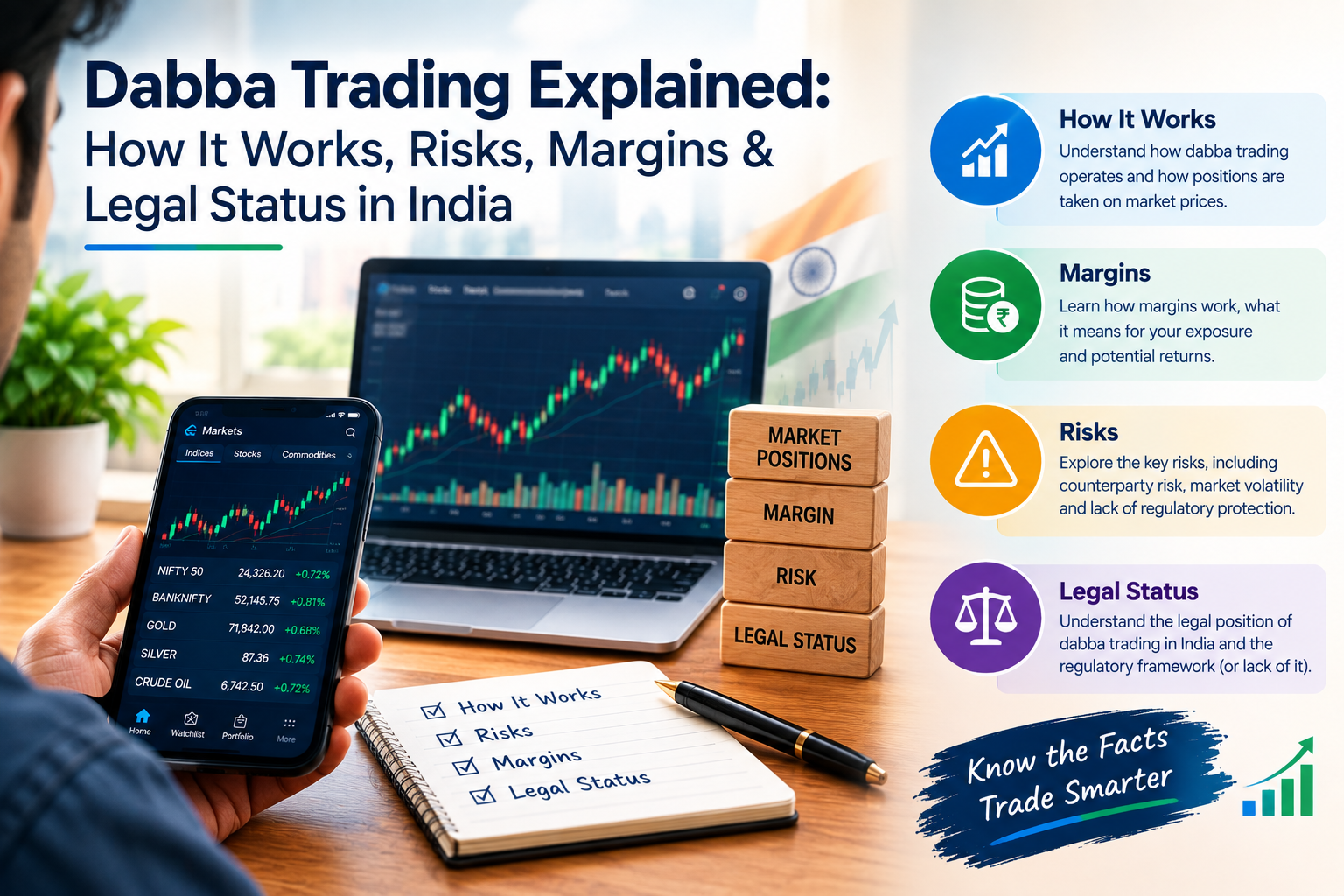
Dabba Trading Explained a term that often appears in discussions about alternative ways of taking positions on market prices. Because it may be promoted through websites, messaging services or mobile applications, newcomers can mistake it for ordinary online investing. The distinction is important. Understanding how the arrangement works, how margins affect exposure and what risks arise outside regulated infrastructure can help people make better-informed decisions.
How the arrangement generally works
In a typical dabba arrangement, a customer communicates an order to an operator, but the transaction is not necessarily routed through the recognized exchange system in the normal way. Instead, the operator records the customer’s position and later calculates gains or losses based on the agreed reference price.
The customer may see market-linked prices and receive an account balance that looks similar to a conventional trading account. The critical difference is what happens behind that interface. If the trade is not actually executed and settled through recognized market infrastructure, the customer is relying heavily on the operator as counterparty.
Why margin attracts attention
Margin allows a trader to control a position using less capital than the full notional value. In informal trading arrangements, high leverage may be marketed as a major advantage. However, leverage works in both directions. A relatively small market movement can create a large loss when exposure is high.
For example, if a trader controls a position several times larger than the cash deposited, even a modest adverse movement can consume a significant portion of available funds. This is why advertised margin should never be considered a measure of safety.
Counterparty risk
One of the key concerns in an unregulated arrangement is counterparty risk. In a conventional market structure, multiple institutions and formal processes support clearing and settlement. In a private arrangement, the customer may depend more directly on the operator’s records and ability or willingness to settle the result.
If the operator delays a withdrawal, disputes a transaction or stops operating, recovering money can become difficult. A trading strategy that appears profitable on paper is therefore not the only consideration; the ability to realize and withdraw funds also matters.
Record keeping and transparency
Users should ask what documents they receive after a transaction. Are there clear order numbers, timestamps, execution details and statements? Can the customer independently verify the transaction?
If records exist only inside a private dashboard, users should understand that the dashboard itself is controlled by the operator. This creates a different level of evidentiary certainty from records maintained within recognized market infrastructure.
Legal and regulatory considerations
The legal treatment of dabba trading in India is an important reason for caution. Activities conducted outside recognized exchange and regulatory frameworks can expose participants and operators to serious legal and financial consequences. The precise legal position can depend on the conduct and instruments involved, so users should not assume that a website’s claims make an arrangement legitimate.
Anyone considering Dabba Trading in India should verify current rules from authoritative Indian regulatory sources and, where necessary, obtain professional legal or financial advice.
Warning signs to notice
Warning signs can include promises of guaranteed returns, unusually high leverage, pressure to deposit quickly, unclear company details, personal payment accounts, vague withdrawal terms and requests to move conversations to private messaging. None of these signs alone proves wrongdoing, but several together should prompt strong caution.
A professional-looking website is not evidence of authorization.
Safer decision-making
People interested in market participation should first learn how regulated exchanges, brokers, clearing and settlement work. Understanding the normal process makes it easier to recognize when a service differs from it.
Regardless of the platform, traders should avoid risking money they cannot afford to lose, understand leverage and keep independent records of financial transactions.
Conclusion
Dabba trading can look similar to ordinary online trading because both may use charts, prices and mobile communication. The crucial difference is the underlying transaction structure. Private settlement, counterparty dependence and uncertain regulatory protection can introduce substantial risks.
Before considering any service, verify its legal status, understand how orders are handled and never judge safety solely by advertised margin or reported profits.
Keyword note: Readers comparing services should research dabba trading platform carefully, verify the operator’s identity and understand how orders, records, settlement and withdrawals are handled.
Keyword note: Readers comparing services should research dabba trading platform carefully, verify the operator’s identity and understand how orders, records, settlement and withdrawals are handled.
Keyword note: Readers comparing services should Research Dabba Trading App carefully, verify the operator’s identity and understand how orders, records, settlement and withdrawals are handled.
Keyword note: Readers comparing services should research dabba trading app carefully, verify the operator’s identity and understand how orders, records, settlement and withdrawals are handled.
Keep independent records
Even when an application provides statements, users can maintain their own simple record of deposits, withdrawals, orders and realized results. Independent records make it easier to reconcile an account and notice unexplained changes.
They also encourage disciplined review. A trader can examine whether losses came from the market, excessive position size, repeated fees or poor execution assumptions rather than relying on memory.
Independent records and careful reconciliation are simple habits that improve financial discipline.
Users should also distinguish between information and execution. A chart can be accurate while the service displaying it is unsuitable for placing a real transaction. Review every important claim independently, especially claims involving regulation, returns, leverage and withdrawals. Taking additional time at the beginning is usually easier than trying to resolve a problem after money has already been transferred.